QR Code


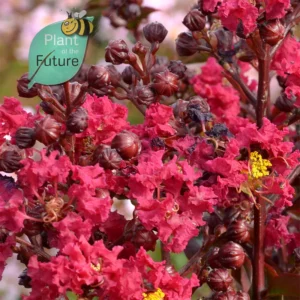
Lagerstroemia indica x fauriei ‘Miss Sandra’
‘Miss Sandra’ originated from a pollination between an unregistered purple-flowered seedling, collected in San Antonio, Texas, as the female parent and ‘Tonto’ as the male parent (Egolf, 1990). ‘Miss Sandra’ was selected as an elite purple-flowered seedling (CM78) among the progeny of this cross-pollination. The new crape myrtle was selected at the Thad Cochran Southern Horticultural Laboratory in Poplarville, Mississippi, a climate characterized as USDA Hardiness Zone 8B (USDA, 2015) and AHS Heat Zone 9 (American Horticultural Society, 2015). Seedlings were screened under normal field conditions in containers with overhead irrigation.
The plants were exposed to intermittent stress conditions caused by full sun, cool spring nights, high humidity, and summer drought. These conditions are generally considered favorable for the development of common diseases in the crape myrtle: bacterial leaf spot (Xanthomonas axonopodis), powdery mildew (Erysiphe australiana), Cercospora leaf spot (Pseudocercospora lythracearum), and the so-called “Rabbit Tracks” disease. Other seedlings tested under the same conditions as the three selections contracted the diseases. The cultivars ‘Miss Frances’, ‘Miss Gail’, and ‘Miss Sandra’ were registered in 2015 with the US National Arboretum, the international registration authority for Lagerstroemia, in accordance with the International Code of Nomenclature for Cultivated Plants – 2009 (Brickell et al., 2009).
(Source: https://journals.ashs.org/view/journals/hortsci/50/11/article-p1721.xml)(Source: https://journals.ashs.org/view/journals/hortsci/50/11/article-p1721.xml)
| Flower color | Purple violet | |
| Blooming period | On average (starting in August) | |
| Max. Height | 400-500 cm | |
| Winterhard | -14 °C | |
| Additional information | Collector plant. |