QR Code


Lagerstroemia indica ‘Rasberry Sundae’®.
(Carl E. Whitcomb, Information Sheet, unpublished; dated 29 July 1991): Selected from more than 65,000 seedlings for its unique flower colour and growth habit. The base of the petal is raspberry red, the outer part is white. The flower heads are large and very eye-catching. Flowering starts later than usual; under Oklahoma conditions, flowering begins in early August. The plants have not formed seeds and once flowering begins, it continues until cooler weather stops growth. The growth habit is dense and pyramidal. Branching is profuse without pruning. Forms an excellent tree with minimal pruning and support. Leaves are medium green and smaller than those of the typical species. The leaves are very long-lived; plants 90 cm tall have a dense leaf mass so no individual branches can be seen. RASPBERRY SUNDAE showed no dieback in the field at winter temperatures of -5°F, -2°F and 0°F, but died down to almost ground level at -13°F. Spring regrowth was rapid and normal. In Oklahoma and Texas, powdery mildew has not been a problem. No research has yet been done on susceptibility to aphids. Damage by ground fleas did occur. Cuttings root quickly and easily, whether softwood, semi-hardwood or hardwood. A plant patent is expected to be filed. (David Byers, Crapemyrtle: A Grower's Thoughts , p. 80, 1997): Each flower is pinkish red with a white edge, from which the name “sundae” (ice cream sundae) is derived. In full sun and on hot summer days, the variegated flowers are red rather than pink. The plant has dark burgundy leaves and grows tall and columnar. Whitcomb says he has found that terminal cuttings more often produce a plant with a central stem. Some powdery mildew occurs in northern Alabama, but in Oklahoma and Florida the plant is reportedly mildew-free. It flowers profusely in the warmest years. The plant grows about 4.5 metres tall and has withstood winter temperatures of -5°F (-20°C) without significant damage. Like most crape myrtles, it roots and transplant very easily. Whitcomb called it Lagerstroemia indica ‘Whit I’ and added the brand name RASPBERRY SUNDAE™. This addition to the crape-myrtle world was patented and introduced in 1996. (Dr Carl Whitcomb, Lacebark Inc, Stillwater, OK, “Five New Crapemyrtle”, undated, unpublished paper received May 1999 at the US National Arboretum, Washington, DC): Lagerstroemia indica ‘Whit I’ , RASPBERRY SUNDAE™ CRAPEMYRTLE. US plant patent no 10297. The flowers are fragrant (reminiscent of a rose). The plant is sterile, although some seed pods do form. Autumn colour is orange-red. Growth is upright, more or less columnar. Cutting off the top creates trees with a central trunk; pruning back the ends creates a tree with several trunks, but very upright. The mature height can reach 4.5 to 6 metres or more. Mildew may occur under extreme conditions in autumn.
= ‘Whit I’ RASPBERRY SUNDAE®.
= ‘Whit I’ RASPBERRY SUNDAE®.
(Source : Checklist Lagerstroemia USDA/ARS National Arboretum )
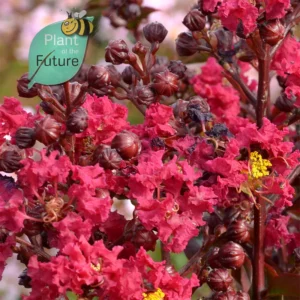
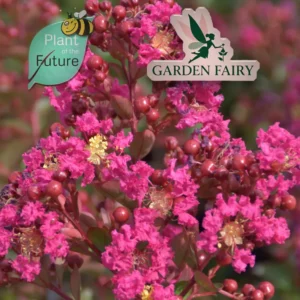
| Flower colour | Red Purple | |
| Flowering period | Late (from September) | |
| Height | 200-300 cm | |
| Hardy | -15 °C | |
| Additional info | Collection plant. The multi-colours are not so pronounced in our condition. |